
Precalc Final Summatives
- Emma Jean

- May 1, 2018
- 3 min read
I am so excited to share with you the end of the year summative assessment that I am doing with my precalculus classes! Because of the structure of my class, I gave a lot of traditional pen/paper assessments. Students did a pass-off quiz at least every other class period. For my final summative, I really wanted to mix things up and get the students to think about each standard in a different way. I was also really inspired by Starr Sackstein's talk regarding reflection and student familiarity with content standards. I was also influenced by Jennifer Gonzalez' podcast episode regarding curation. Finally, I wanted the students to re-familiarize themselves with our content standards but not kill themselves by trying to memorize the mathematical processes and minute details associated with each. Ideas began to brew in my head.
I began designing a portfolio project. The portfolio would have five artifacts in it. One artifact for each unit that we studied this year.
From each unit, the students would pick the content standard most difficult for them. This would address the issue of trying to cover too much at once. They would be forced to review all the standards from the unit in order to make a good choice but would only be required to look deeply into the one posing the most challenge.
Then, with that standard they would try to learn it a little better than they did the first time around.
The first step is to summarize the standard and write it in their own words. This requires synthesis of their knowledge.
The next step is to reflect: what made the standard so difficult? What did you do to learn it? How did you know you got it? What questions do you still have? This requires metacognition about the learning process and encourages a growth mindset. When I described this part in class, a student asked me, "What if we never learned it?" I responded, "Well, that's the whole purpose. Now you have a second chance."
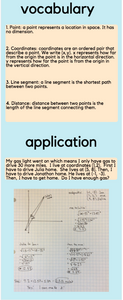
The third step is to demonstrate that you know it now. I asked them to list the relevant vocabulary or formulas needed to understand the standard. This ensures that they are at least a level 2 on the proficiency scale. Then, they also have to come up with an example problem, solve it, and explain their work to ensure that they are at a level 3 on the proficiency scale.
Finally, I ask them to find an application for that standard outside of the context of our class. They need to transfer the knowledge.
I tried to provide students with a ton of scaffolding to make the process of completing this project smooth and efficient.
One piece of scaffolding that I provided is a checklist and detailed description of the expectations. (Though not pictured) I also included a list of all the content standards for each unit.


I also provided a template on google slides that has a box labelled with each of the required elements. While they have creative reign and can produce any product they choose, I wanted to give a template for students that just want to focus on content rather than making something pretty.


I made an exemplar that I spent about 20 minutes going over with my students in class so that they could see exactly the caliber work I was expecting.


I gave them a 30 minute planning period to go through all of their resources for the year to pick one standard from each unit to focus on. This was a really interesting process to observe. Some students went directly to their pass-offs. They thought that if they chose the standard that they got the lowest grade on, that would represent the one hardest for them. I encouraged the to look more deeply, try the questions on the pass-off again, try to remember how it felt to learn that topic. Others referred to their progress trackers to see how long it took them to achieve mastery on certain standards. Others re-watched videos and tried to interpret the AERO standard language in the context of our class.
I collected the list of their most difficult standards from each unit and agreed to give a mini lesson targeted towards those standards each day for each unit as they work on their projects.
This planning period was extremely satisfying as a teacher. I heard lots of great discussion. "Oh, yeah! I remember that the circle equation was really hard for me!" and "Wow, I can't believe it didn't understand this back then. It seems so easy now!"
I can't wait to see how the projects turn out. I'll update soon with pictures!


Comments