
More alignment! How to align resources to your proficiency scales.
- Emma Jean

- Mar 17, 2018
- 3 min read
Updated: May 18, 2018
In this installment of CBE bootcamp, we'll talk about how to use a proficiency scale to plan instruction and delivery of content. Some key things to pay attention to as we explore this example are:
The "breakdown" of your standards continues to play a major role in planning.
Students learn in different ways and should be provided more than one resource for learning content.
Similarly, students should be provided with more than one method of getting familiar with that content.
Students should know exactly what is expected of them.
Proficiency Scales are wordy and can be confusing! I hope that this example shows how I try to make them more digestible for my students.
Let's take another look at the symbol-coded proficiency scale that we discussed last time.

Here, the standard was a doozy: three whole bullet points worth of material. It took a lot of unpacking as you can see by the quantity of level 2 bullet points. In the last post I showed how my assessments are designed to align with this proficiency scale. Here, I'll give an example of how I used the breakdown of this standard to determine delivery of content. Similarly, in the images that follow, you can follow a certain icon to see where it is addressed in my instruction and content delivery.
The first step for me is to look at the textbook that I provide as a resource for my students. I determine which section of the book houses the relevant content and which problems at the end of that section are good examples of ways that the students can both practice and demonstrate mastery of the various skills.
The next step is to create videos that address each of the necessary skills. I use screencastomatic.com paired with a ladybug doc cam to make these videos. With the doc cam I can film my own handwriting and with screencastomatic, I can record the screen showing this image as well as record my voice and my face. I experimented with a lot of other flipped learning technology and settled on this as the best. Perhaps I'll do a post some time about the technology out there for producing videos like this.
Next, I look for other resources that were aligned in these skills. Because we use AERO standards there is a lot out there. My students tend to like Khan Academy so I often include links to those videos as an alternative to my own. I also often include explorations on desmos.com. They have a great feature that allows teachers to create activities for students that guide them to discover certain principles. I did not include anything from desmos for this particular standard.
Finally, I find online practice problems. My department subscribes to IXL, an online problem solving database that I absolutely love. It is great for competency based education because each problem set does not have a required number of questions. You earn points as you answer correctly and lose them when you answer incorrectly. Thus, your goal is to reach a certain mastery score rather than do a specific number of problems. (More on this in a later post). I list the IXL problem sets that are relevant to the skills in the given standard.
I try to have a balance between pen and paper resources and technology resources. That way students have some voice and choice in how they both obtain and practice the content.
Once I have my resources gathered, I create a google doc (as shown below). The template is:
Standard:
Learning Targets:
Checklist of what the student should do to master the material. The checklist contains the various practice problems and online problem sets that I have identified, filling out a notes outline, and taking a practice pass-off.
Resources for learning the content. These are the text, video and digital resources I have produced or found/vetted.
Notes outline: highlighting the necessary vocabulary and skills as indicated by the level 2 of the proficiency scale.
Practice Pass-Off: A practice version of the assessment. The practice pass-off is almost identical to the assessment. strongly believe that students should be completely aware of what is going to be expected of them on an assessment.


I provide this guide to the students for every standard. Again, if you follow the symbols from the proficiency scale to the Standard Guide, you can see that everything on the guide is relevant to the proficiency scale and conversely, every bullet point in the proficiency scale is represented in the guide.
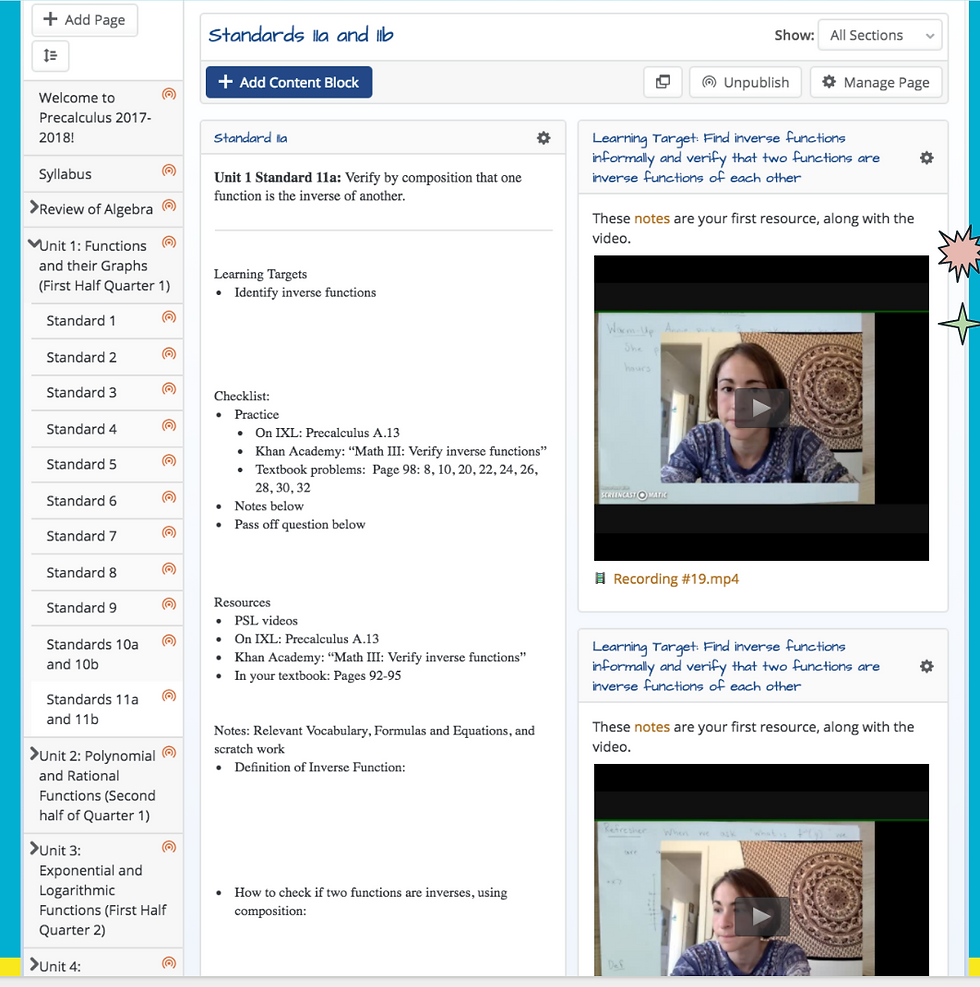
Finally, I post all the videos as well as a digital copy of the guide on our LMS (We currently use powerschool but next year will be switching to Schoology.)
As I write this, I realize that there is so much more to say here! I want to talk about voice and choice, technology, learning styles, pacing and more but I think this is enough for today.


Comments