
Voice and Choice
- Emma Jean

- Apr 7, 2018
- 8 min read
Updated: Apr 17, 2018
Teaching high school students is not easy. These students have so many things going on: college acceptances, drama with friends, fights with parents, training for athletics, budding romances, sleeping, changing bodies, and so much more. It’s not always easy to convince them that practicing the application of the law of sines is particularly important. We as teachers need strategies for motivating you minds and offering choice in the classroom is a great way to do that.
We can offer choice in many different ways. We can offer students choice in
the content they explore
the process they use to learn the content
the order that they learn content
the timeline of their learning
the products they use to demonstrate their learning
the location or environment in which they learn
and I’m sure there are others.
Now, I understand that not all of these are attainable. You might teach at a school where the content is decided for you and there is no flexibility. You may be preparing your students for a standardized test and the content needs to be mastered by a certain date. You may have a classroom with exactly 24 desks and they are nailed into the floor in perfect rows. That’s OK! We can’t offer choice in all of these areas at once, nor could we as human beings manage a classroom where students had free reign over all of these things. I’ll talk about ways which we could offer choice in each of these areas, talk about how I do it in my classroom and talk about baby-steps that we can all take to give students more choice.
Content:
We would all love to let the students simply follow their passions and study whatever they want. Some schools are able to do this quite well. The Apollo School is a wonderful example of this. The school is purely project based. There are a set of skills based standards that the students are expected to demonstrate mastery of, but because the standards are broad enough, the students can design projects in any content area of their choosing to meet the requirements.
However, allowing the students choice in content is a tricky one for most teachers. We all have curricula and many of us have standardized tests that students need to be prepared for. Offering a bit of choice is not impossible however. Here are two ways that I do it.
In AP Statistics, when we are exploring different representations of data and summary statistics, I let the students choose their data sets. They can choose from political data, data collected from students at our school, sports data, medical data. While they are all practicing the same mathematical skills and doing the same computations, the results that they are drawing feel more relevant to them because the data has meaning and THEY got to pick what interests them most. This could be done in a humanities class too. If your goal is to teach about the rise and fall of conflict let students choose from a menu of case studies to analyze. Even better, have them share what they learn from their case study with other students afterwards so they get exposed to different ideas and can compare and contrast.
Another way in which I give students choice in content is in my precalculus class. I always plan some flex weeks at the end of the school year for student choice projects. Students are asked to choose from a menu of topics and learn as much as they can about it. They are tasked with creating their own unit on the topic in the style that our class runs in. The must identify and define key vocabulary, identify and explain key skills, and finally show examples of the skills.

Process: We can also offer our students choice in how they learn the content. When I first attempted to flip my classroom I spent hours creating countless hours creating videos of all my content. I put tremendous effort into these videos and thought they were all magnificent. When I began hearing the chorus of “I can’t learn from video!” I was distraught, but it’s true! Not all students can learn from video. I didn’t delete all of my videos I just developed more resources. I provided textbook pages with aligned content, I gave links for online explorations, I sent links for videos created by others, and I began offering mini-lectures in class. I transitioned to telling the students what they needed to know and letting them figure out how they wanted to learn it. You can do this too! Even if you primarily lecture, try recording your lectures so that you students can watch or listen later. Give readings that go over the same content. It helps to have a notes outline of key points that students can fill ins the learn, using whatever method they choose. This helps to ensure that they students receive the essential content regardless of process.
Order: Sometimes we can’t let students choose the content but we can let them choose the order in which they learn it. For example, when teaching trigonometry, there are many different angles to explore. You could learn the definitions of the trigonometric functions as ratios of a triangle and then extend this definition later. You could first define the trigonometric functions using the unit circle and then study them within a triangle as a special case of this, or you could first introduce the graphs of the trigonometric functions. In my trig unit, I briefly introduce all of these concepts and I number the standards in the sequence that I find most logical but I give the students other logical sequences as well.
1, 2, 3, 4, 5, 6, 7, 8 is the sequence that I find most logical.
6, 7, 8, 3, 1, 2, 3, 4, 5 is the sequence that follows logically if you want to study graphs first.
4, 5, 1, 2, 3, 6, 7, 8 is the sequence that starts with triangles and builds and expands from that.
More visual students usually choose the second path. Students who are struggling and want to feel grounded in something they have seen before take the third sequence and the majority of students follow the first path.
It may not be possible for you to give this much freedom. If you have two topics where the sequence doesn’t matter give two possible sequences: group 1 does topic A first then B and group 2 does B first then A. Alternate your instructional days between group 1 and group 2. While you are working with group 1, group 2 can do do independent or group work and vice versa.

Timeline: By giving students choice in timeline, I don’t just mean the order of the content, I also mean the deadlines. This is the self-paced classroom. If you don’t have the flexibility to let you students work completely at their own pace, you can still give them some choice. One way that I do this is by giving students a deadline for a set of standards. I then give them a blank calendar and the list of tasks that need to be accomplished. They fill in their calendars with goals for each day in such a way that everything gets done. I keep a copy and the students keep a copy. At the end of each class, I walk around with my binder and check in with each student, “did you meet your goals for today? If not, what will you do to get back on track? Do you need to rearrange your calendar?”
Products: This is a common way to give students choice. The key here is that when we assess we should be assessing based on content mastery rather than artistic talents. Why make every kid draw a poster? This is SO boring to grade. Plus, the students often have really great ideas and come up with creative products on their own. I gave a project in which I asked students to create a guide for graphing rational functions. I told them that they need to describe how to determine end behavior, identify vertical asymptotes, find zeros, and plot test points to connect the graph. They had to show how to use their guide by actually graphing a few rational functions. The products were amazing. A got a cookbook, a podcast, a fortune teller, a book, a flip chart, a flowchart and of course plenty of posters. It was awesome, though! So much more fun to grade than 75 tests…
Location: I think that everyone recognizes that school desks are not always the most comfortable. We would all love to have classrooms like this:

with sofas, couches, lounge chairs, bean bag chairs, rolly desks! I’m getting excited just thinking about it! But, alas, most of us are constrained by budget, classroom size, number of students and fear of chaos. Despite all these constraints we can make some changes and give students a few choices. I change the arrangement of my classroom regularly. I have some desks set up in tables of four, some in tables of six, some by themselves. I push some of the desks so that they face the wall, others facing the front, others facing the mountains out the window. This helps students find places that help them focus best.


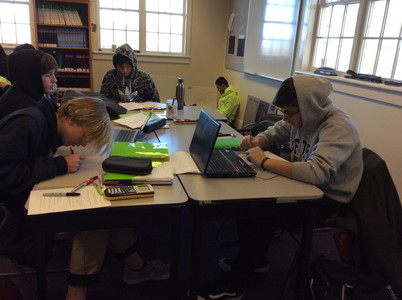


On discussion days I set up the desk in a big U. One day, I got rid of all the chairs and we spent the whole class sitting on the floor in the middle of the room. If students are watching videos and need a quiet space I let them watch in the hallway. We also have a copy room that I let students use if they are taking a test. All of these options give students a little choice in an otherwise conventional space. THIS PODCAST has some great general ideas for using space wisely, especially under constraints.
One important thing that I haven’t yet touched on in this post is student’s ability to make choices. In our most recent professional development at school we were asked to react to a variety of statements. One of which was “Students are not mature enough to make their own choices.” We were asked to go to different corners of the room based on whether we agree strongly, agree, disagree and disagree strongly. There were a heck of a lot of teachers in the “strongly agree” corner. I was surprised! This is because they have tried giving their students choice in class and has really negative experiences. Students will kind of just sit there or they’ll ask, “what’s easiest?” Yes, this definitely happens, in my classroom too, especially at the beginning! But, I strongly believe that student’s difficulty in making good choices is not because they don’t want the, or don’t have the maturity to do it; it’s because they’ve never been given choice before. They have never had to make decisions about their learning and they don’t know how! We must teach them! When you first start offering choice make sure to support your students toward good choices.
Ask them guiding questions about their learning preferences and give them suggestions. Here are some guidelines that I try to follow.
Tell them to try one way today and try another way tomorrow and compare.
At the end of class have them reflect on the choices they made that day and this about whether it worked for them or not.
Try to make options that are comparable in difficulty so that there is no temptation to take the easy way out.
When students consistently make poor choices, take the choice away for those few (not everyone) until they demonstrate the ability to do better.
Don’t give up on giving options if it doesn’t work at first! It will get better.


Comments