
Proficiency Scales
- Emma Jean

- Mar 14, 2018
- 3 min read
Updated: May 18, 2018
Just about everything that I'll say in this post either came from or was inspired by Marzano Research. I can't take credit for the ideas behind proficiency scales or even some of the wording used in my examples. Some good references for learning more about proficiency scales are
1. Marzano, Robert J. Formative Assessment and Standards Based Grading. Bloomington: Marzano Research, 2010. Print.
2. Marzano, Robert J.; Norford, Jennifer; Finn, Michelle; Finn, Douglas. A Handbook for Personalized Competency Based Education. Bloomington: Marzano Research, 2017. Print.
Now, with that disclaimer out of the way, let's get into it!
A proficiency scale is essentially a formalization of what we discussed in the last post: breaking down content standards. However, it goes slightly beyond the brainstorming stage by carefully outlining what students must actually demonstrate in order to show mastery of that standard. Furthermore, it delineates the necessary knowledge into three (sometimes four) different levels of mastery.
Level 3 is "At standard". On a proficiency scale, this should be the exact phrasing of the content standard. Students are at a level three if they can achieve the content standard as it written with no guidance or help from their teacher.
Level 2 is "approaching standard". This is the hardest part of the scale to write because it contains all the details and meat of the standard. Not to worry, though! You did most of the work already if you did the brainstorming step of breaking down each content standard. Here you will list the vocabulary and the individual skills and background knowledge required to demonstrate mastery. It is also helpful to add in examples of questions or tasks that might be used to assess whether a student has achieved each of the skills. A student needs to be able to synthesize all the bullet points in a level two before she can succeed at a level three. Level two is important because this is where the learning happens. If a student is not able to complete the task which assesses the standard itself, the bullet points in the level two category can help you diagnose what background knowledge is missing.
Level 1 is essentially the "pre-learning stage". A student is at a level one if they have not yet been exposed to the material or if they can only achieve some of the level two skills with help from a teacher or peer.
Level 4 is when a student shows excellence above and beyond what the standard is asking. It usually requires significant higher order thinking and reasoning to achieve.
In my proficiency scales, I choose to allow 1.5, 2.5, and 3.5 because I think it's important to show the students that they are making progress! Sometimes it takes a long time to master a standard and I don't want my students to feel like they are stuck at a level 1 even if they are learning.
Now that we've got the basics down, let's look at an example. Last time we explored the standard:
AERO.HSF.1F.4 For a function that models a relationship between two quantities, interpret key features of graphs and tables in terms of the quantities, and sketch graphs showing key features given a verbal description of the relationship. Key features include: intercepts; intervals where the function is increasing, decreasing, positive, or negative; relative maximums and minimums; symmetries; end behavior; and periodicity.
This means that I literally put this wording directly into the level three:

From there, I broke down the standard and my brainstorm for looked something like this:

and this led to a detailed outline for level 2 which looked something like this:
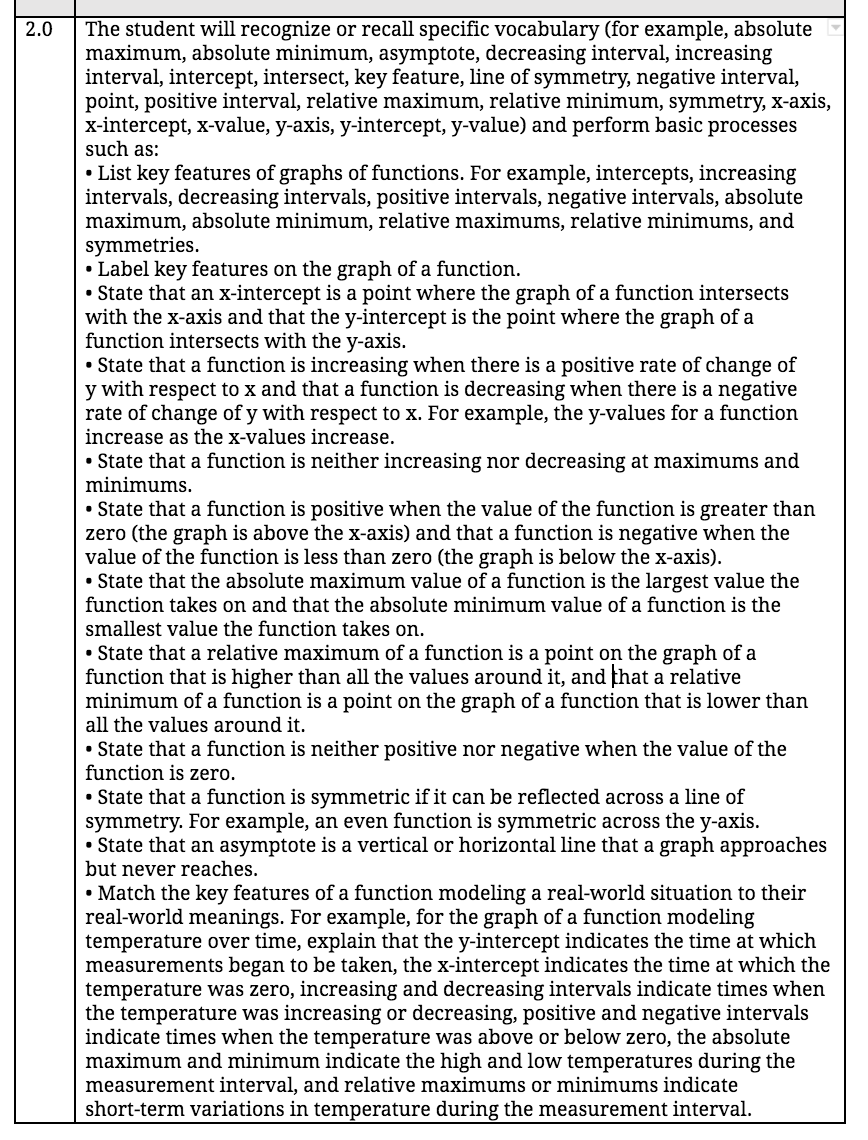
Notice that it starts with the vocabulary. Then, each bullet represents one of the key skills. The verbs in the skills like "label, state, and match" show that level 2 primarily addresses the knowledge aspects of this standard rather than the product aspect. It makes sense! Clearly, you must be able to state what it means for a function to be increasing before you can sketch a function that is increasing on a specified interval!
The verb "match" also indicates that matching activities will be used to assess this particular skill.
Level 1 of a proficiency scale always looks the same, so the bottom of this proficiency scale (and all proficiency scales) was:

I hope this brief intro to proficiency scales was useful! Next post, we'll learn how to use them to align assessments.


Comments